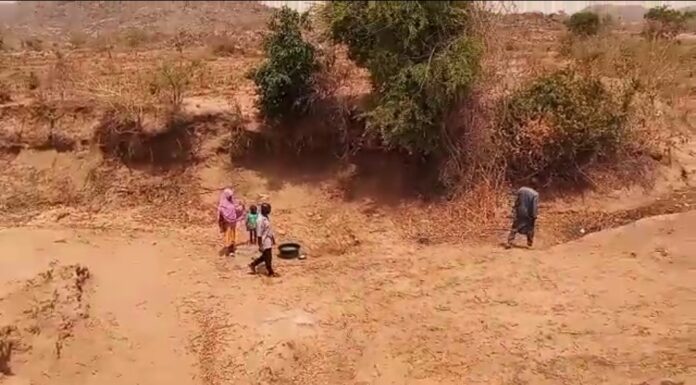
Residents of Bilin Gumi village in Toro Local Government Area of Bauchi State are risking their lives daily to access water from contaminated sources infested with snakes and other dangerous reptiles.
For decades, villagers, mostly women and children, have had no access to clean drinking water. They trek long distances to fetch water from open, dirty rivers. There, they encounter snakes, scorpions, and other hazards that turn a basic need into a life-threatening task.
Malam Abdullahi, a resident who spoke to WikkiTimes, explained how women and children trek for kilometres to fetch dirty water from open and dirty rivers, where they encounter snakes and scorpions.
He said a lack of a safe water source has turned ordinary daily routines into a perilous survival task for the residents.

“We were here for over 80 years without clean water, and we have never gotten any support from any government. Our children fight in the river for water,” laments Malam Abdullahi, the Baraya of Bilin Gumi.
This reflects the plight of a community long abandoned by government systems meant to provide basic social amenities.
According to him, the village’s only available water comes from a stream polluted by animal waste and plant debris.
“The stream is also home to snakes and scorpions, which residents frequently encounter during their desperate search for water.
“We share contaminated water with snakes, scorpions, and other animals,” Abdullahi said.
Malam Isiaka Wakili, the Wakilin Bilin Gumi, corroborated, “The government is absent here, and we have never enjoyed any dividend of being citizens.”
For the people of Bilin Gumi, accessing water means not only trekking for several kilometers to access borehole water in faraway neighbouring communities or surviving through the risk of snakes to get water from a stream.
Women Bear the Heaviest Burden.
Malama Ladi, a resident, told Albarka Radio her experience and the struggles they endured, especially during events like weddings, just to get water. “When there is a wedding here, we must go several kilometres to fetch water. We would leave early, and we use torchlights in the stream against snakes and other dangerous animals,” she says.

Ladi added that the water stream in the village becomes even more dangerous at night, but due to high water demand, night trips are unavoidable.
For postnatal care, basic hygiene is crucial, but in Bilin Gumi, that is an almost impossible dream.
Malama Rakiya Banzata, another resident, highlighted the suffering of mothers in the area. “No water even for women post-natal. No water at all sometimes. Our children can’t have enough sleep,” she says, describing how babies cry through the night due to heat and thirst.
The villagers say politicians only show up during campaign seasons, making lofty promises, and then vanish once elections are over.
“We deserve at least clean water. Something must be done to get us out of this suffering,” argues Wakili.
Water Crisis in Nigeria
According to UNICEF, 70% of drinking water at the source and point of consumption within households is contaminated in Nigeria. This is affecting about 70 million Nigerians, with rural dwellers suffering more.
WikkiTimes reports that in Bauchi State, despite multiple World Bank-funded and federal water projects, communities like Bilin Gumi continue to suffer in silence due to mismanagement, neglect, or sheer lack of political will.
RUWASSA Speaks
Habibu Mohammed, Acting General Manager of Bauchi State Rural Water Supply and Sanitation Agency (RUWASSA), told WikkiTimes that communities in need of water intervention should channel their requests through the Local Government Water, Sanitation and Hygiene (WASH) unit.
He said the unit will compile and forward such requests to the RUWASSA office in Bauchi for proper assessment and possible action.
Health experts warn that such exposure to contaminated water can lead to widespread outbreaks of cholera, typhoid, and skin infections, conditions that frequently ravage rural areas but often go unreported.
The villagers are now calling on the Bauchi State government or other partners to intervene to rescue them from their situation.