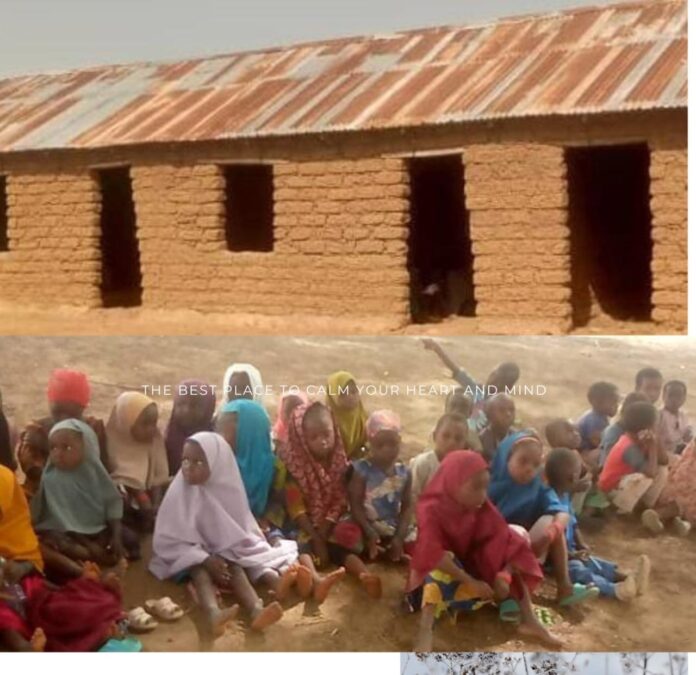
In the quiet village of Wuro Jiba in Tafawa Balewa Local Government Area, Bauchi State, a group of farmers gathers every week, not to discuss markets or yields, but to discuss how to raise money to complete a school building.
This is not an isolated case. In Kwaram, Dass LGA, the community decided to fix the problem on their own after witnessing the collapse of their government-built school.
These communities are building their own schools literally with bricks, rice harvests, and donations. The children would now learn in classrooms made possible not by the government, but by their parents, community members, and rice farms.
The School Dilapidation
For years, the residents of Wuro Jiba endured the absence of a functional school building. The one provided by the state government had fallen into such disrepair that it eventually collapsed, forcing children to learn under unsafe conditions or drop out of school entirely. Unwilling to wait indefinitely for external aid, community leaders, parents, and religious figures united to take action themselves.


Community-Led Solutions
Sa’idu Magaji, the village head of Wuro Jiba, explained how the project began. “8 months ago we came together and planned to at least build a mud school. But after our plea was aired in the media, people including alumni of our community’s Islamic leader began donating. That’s how we received 16 bags of cement. We changed our plan from mud to cement blocks.”
The community pooled money, labor, and materials. They raised ₦100,000–₦150,000 (about $100) through local donations and farming. Every household contributed. Young men cultivated rice and soybean on community land, while women fetched water and provided meals for workers. Together, they molded blocks, laid bricks, and slowly raised two new classrooms.
“The district set aside a communal farm,” said Musa Ibrahim Talban Bula, representative of the district head. “We grow rice and soybeans. When it’s time to build, we sell some produce to buy materials.”

The Ripple Effect
The community’s effort did not go unnoticed. Local government education officials visited the community and pledged to construct a block of classrooms worth ₦38 million. They also announced plans to upgrade the school from a primary to a junior secondary institution. However, that promise has yet to be fulfilled.
In Kwaram, Ahmad Yusuf, the village head, said a storm tore off the roof of the government-built school. Despite repeated appeals to the state government, no help came, and the building eventually collapsed, forcing children out of school. Refusing to wait any longer, five neighboring communities—Barza, Gangare, Sabon Layi, Kwaram, and Buntal—joined forces to rebuild the school themselves.

This collapsed structure was the only primary school serving all of Kwaram community now abandoned and battered by climate change.
“We formed a committee and built it with our own hands. Even women contributed,” said Ayuba H. Madaki, Sarkin Gangare (Leader of Gangare District). “During the rainy season, children often return home dirty and sick. We had no choice.”
Women Drive Support
Back in Wuro Jiba, women like Habiba Adamu were instrumental in ensuring young girls had access to education in the newly rebuilt school. “We went door to door to raise funds. We cooked for the men working at the site and helped however we could. We want a school for girls too,” she said.
Amina Idris from Kwaram shared that women from her village and nearby communities contributed their finances to purchase building materials. “We can’t keep watching our children grow up without an education,” she said. “We just have to do whatever little we can.”

The Limits of Community Effort
Even as Wuro Jiba and Kwaram communities take charge of their children’s education, harsh realities persist.
In Kwaram, where villagers rebuilt their classrooms with mud, the children now learn on bare floors. The building has no windows or doors, making it unusable whenever it rains. Meanwhile, in Wuro Jiba, although the community is constructing a block of classrooms with cement bricks, the structure is only nearing the linter level. Until it is complete, pupils still gather under trees for lessons.


These communities have shown remarkable initiative, but they remain constrained by poverty, geography, and lack of government support. Their efforts, while inspiring, highlight a deeper crisis: rural education in Bauchi is still far from accessible or safe for many children.
A Bigger Question
The efforts of Wuro Jiba and Kwaram spark a deeper reflection: What does it say about governance when citizens must grow rice, mold bricks, and pool personal savings to build a classroom when billions of naira is budgeted for basic education?

In 2021, with a ₦4.24 billion revised budget, just ₦117.56 million was released, a mere 2.8% budget performance. The following year 2022 was worse, ₦39.52 million was spent out of ₦2.54 billion budget, equals to 1.6 % budget Performance. Although 2023 and 2024 saw better implementation with ₦621.45 million (34.7%) and ₦4.56 billion (73%) spent respectively,
The 2025 education budget is even more ambitious at ₦14.55 billion. Yet, as of the first quarter, only ₦754.88 million has been spent, just 5.2% of the total. While money remains on paper, children in these villages still sit on bare floors or learn under trees, and communities like Wuro Jiba and Kwaram are still building their own classrooms from scratch.
Government Response: Promises, Processes, and Gaps
When asked about the unfulfilled ₦38 million classroom block reportedly pledged during a 2024 visit to Wuro Jiba, Isa Jugundo, Public Relations Officer of the Bauchi State Universal Basic Education Board (SUBEB), clarified that no such project was included in the Board’s original implementation plan. He explained that the visit was only an assessment. However, he confirmed that a new classroom project for Wuro Jiba has been added to the 2025 budget and, once awarded, contractors will build classrooms with standard specifications and provide furniture.
Jugundo also addressed why SUBEB had not intervened in Wuro Jiba earlier, despite years of basic education funding. He explained that interventions follow a multi-step process based on priorities submitted by local governments: “We usually ask LG chairmen to meet with community leaders, pastors, imams, and others to determine and prioritise their needs. If a school isn’t listed as a priority, we might miss it like what happened with Wuro Jiba and Kwaram.”
This process raises concerns about equity in project selection. It reveals how a community’s needs can be overlooked if not properly relayed through political or bureaucratic channels.
Jugundo added that SUBEB commends the grassroots efforts in Wuro Jiba and Kwaram. While they don’t offer reimbursement for community-built projects, they may provide support such as chalk, registers, or desks when resources are available. “We also register community requests and consider them during future intervention funding cycles,” he added.
A Model of Community-Driven Solutions
These stories are not just tales of neglect, they are blueprints for resilience. Through collective farming, fundraising, and advocacy, rural communities are creating their own lifelines. Yet, they should not have to do this alone.
Mr. Ali Baba Dalhatu, Chairman of the Nigeria Union of Teachers, emphasizes that community-funded school projects should not be viewed solely as a government failure but as a complementary effort to strengthen education. He highlights the need for greater transparency, urging the government to regularly publish expenditure reports and conduct awareness campaigns to foster public accountability. Dalhatu also calls for policy reforms, including the establishment of procurement departments in SUBEB, Local Education Authorities, and education ministries to ensure proper use of funds. “Education for all is a shared responsibility,” he says. “Communities receiving more subsidization and actively supporting their schools adds value to the education system.”
For the children of Wuro Jiba and Kwaram local government areas, a desk, a roof, and a blackboard are not too much to ask – yet, they remain out of reach. Their communities have shown what is possible. Now, it’s the government’s turn to deliver on its responsibilities.