For the first time in five years, the abandoned health centre in Barden Barade, a remote village on the dry plains of Sokoto State, flickered back to life — not just with electricity, but with hope and dignity.
Once a symbol of state neglect, the primary healthcare center had stood shuttered and silent, its wards stripped of beds and equipment. Women in labour were forced to travel over 20 kilometers at night in search of care. Others delivered babies on mats inside the abandoned hospital, aided only by midwives clutching phone flashlights between their teeth.
“Many of us feared we wouldn’t survive childbirth,” said Maryam Abubakar, a mother of four. “My last child was born on the floor, under the light of a phone torch the nurse held in her mouth. I cried — not just from the pain, but from fear.”
That fear was replaced with joy recently as the Centre for Renewable Energy and Action on Climate (CREACC-NG), a Nigerian nonprofit working on community resilience and climate justice, launched its HealthVoltaic Initiative in the village. The programme, designed to electrify off-grid rural health centers with clean energy, brought solar power, essential equipment, and life-saving services back to the heart of Barden Barade.

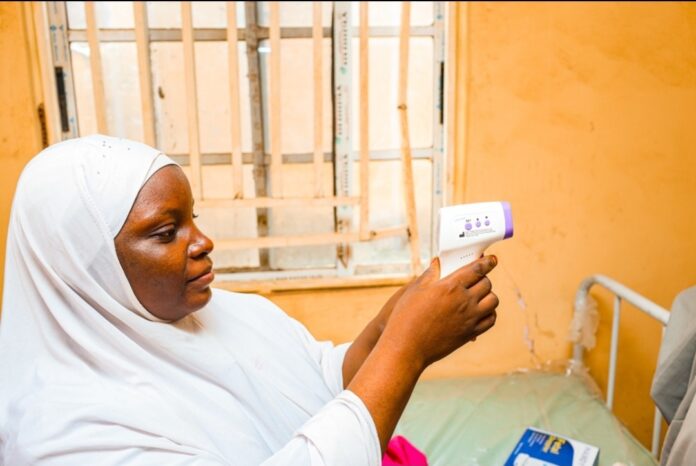
With support from local stakeholders and donors, the newly installed HealthVoltaic system included a solar generator and roof-mounted panels, rechargeable lights and ceiling fans, modern medical equipment, including Doppler fetal monitors and digital thermometers and new hospital beds and emergency supplies.
For the first time in years, the hospital’s delivery rooms reopened. Wards once cloaked in darkness are now illuminated 24/7, enabling night-time care and emergency responses.
“No woman will give birth in the dark again,” said Umma Muhammad, the Officer in Charge of the hospital. “No more torchlights in our mouths. No more deaths because there was no light. This is a new beginning.”
At the launch ceremony, Alhaji Mamman, the traditional leader of Barden Barade, struggled to hold back tears.
“For years, we begged for help. We watched our women suffer. Today, we have light — not just in bulbs, but in our hearts,” he said. “This is one of the greatest things to happen to our community.”
Women ululated. Children danced around the solar panels. And members of the Ward Development Committee (WDC), who oversee the hospital’s welfare, pledged to protect the new infrastructure.
“We’ve waited so long,” said Malam Nura, a WDC member. “Now that it’s here, we won’t let it fail. This energy system is for our mothers, our babies, and our future.”
The transformation at Barden Barade is a pilot phase of what CREACC-NG hopes will become a nationwide revolution. With over 55% of Nigeria’s primary healthcare centers lacking electricity — and one woman dying every 13 minutes during childbirth — the stakes could not be higher.
“This isn’t just about light,” said the HealthVoltaic project lead. “It’s about restoring dignity to rural healthcare. No woman should die giving life simply because there’s no power.”
The HealthVoltaic Initiative aligns with Sustainable Development Goals 3 (Good Health and Well-being) and 7 (Affordable and Clean Energy). Designed to be low-cost, climate-smart, community-owned, and scalable, the model offers a practical solution to Nigeria’s healthcare and energy deficits.
Once dismissed as a forgotten village, Barden Barade today stands as a beacon of what is possible when communities organize, NGOs act, and light returns — not just to buildings, but to lives.
As the sun set after the launch ceremony, the lights inside the health center stayed on — glowing softly, like a promise kept. In that light, babies cried, midwives smiled, and a future once darkened was illuminated again.