By Muizat Abubakar
“(School nah scam) is a reflection of the frustration of a generation of graduates who did everything right but still struggle to find opportunities,” said Muneer Yakub, a doctoral scholar of Texas University, Dallas, United States of America (USA). “To succeed, you need to be intentional about school by seeking practical experience that makes you valuable and adaptable,” he continued.
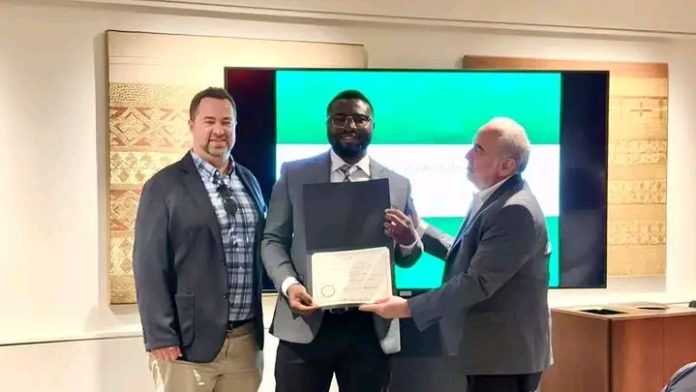
Dr Yakub is an alumnus of Usmanu Danfodiyo University, Sokoto (UDUS), one of the leading universities in Northwest Nigeria. He recently clinched the Outstanding Graduate Student Award (PhD) for the School of Natural Sciences and Mathematics. The recognition conferred by the Office of Graduate Education, celebrates not just academic excellence but leadership, research impact, and service to the university community.
He also emerged as the overall winner of the Outstanding PhD Award for the US varsity in 2026.

Before the recent accomplishments, Dr. Yakub has distinguished himself both in academics and leadership. Within his stay at the university, he received 16 awards, including the Julia Williams Van Ness Merit Scholarship, alongside the Natural Sciences and Mathematics Travel Award.
He also held multiple leadership roles; Graduate Representative in the Graduate Student Congress, President of the International Student Ambassador Program, and Graduate Representative on the University Education Committee.
Amid multiple postdoctoral offers readily available, Dr Yakub is determined with his academic journey, saying “I’m looking at opportunities in research, either in industry or academia. In the coming months, I’ll decide where to go next.”
Yet, behind these left-and-right achievements lie a deeper story, one that raised questions of excellence compensation in the Nigerian education ecosystem.
Hailing from Oyo State, Southwest Nigeria, Dr Yakub was born and raised in Nigeria’s megacity, Lagos. Recently, he concluded his PhD program on scholarship at the University of Texas, Dallas, where he studied Molecular and Cell Biology. His research focused on antimicrobial therapy.
His journey to academic excellence was never a straight path. Like many Nigerian students, his early post-secondary days were marked by uncertainty, marred with repeated attempts to secure admission.
“I wrote the Unified Tertiary Matriculation Examination (UTME), organised by the Joint Admission and Matriculation Board (JAMB) exams twice and scored 220 both times. I initially applied to Obafemi Awolowo University (OAU) in 2014, but when my West African Senior School Certificate Examination (WASSCE) result came out, I did not clear all my papers,” he recalled.
After sitting for the General Certificate Examination (GCE) and UTME in the following year, he applied to study Medicine and Surgery in UDUS “most peaceful university in Nigeria”. However, an error occasioned during the post-UTME examination altered his fate.
“I got three papers instead of four during the exam, which affected my score. Eventually, I was admitted to study Microbiology in 2015,” Dr Yakub said, reminiscing about his first year as an undergraduate.
“I accepted the admission with the intention of rewriting JAMB. But in my first semester, I fell in love with the course, the curriculum, my lecturers, and my course mates so I decided to stay.”
Dr Yakub embarked on his academic pursuit confidently in UDUS. He finished his first year with a strong CGPA of 4.75, maintaining his first-class standing into the second year. By his third year, the grade continued dropping until he eventually graduated with the CGPA of 4.37 (second-class upper) in 2019
What many framed as a “grace-to-grass” story marked a defining moment in his academic career. He was actively involved in extracurricular activities on campus, positioning him for pregnant success. “My CGPA dropped in my third year because I became actively involved in extracurricular activities.”
He was appointed as Editor-in-Chief of Ad -Daleel, becoming a campus journalist with Digest Press. Dr Yakub finally rose to serve as the President of National Association of Campus Journalists (NACJ), UDUS Chapter.
The deanery recognized his active involvement on campus, the reason for his selection among the members of the electoral committee that oversee the conduct of the 2019 Student Union Government (SUG) election.
“During my SIWES, I interned with The Nation Newspaper where I gained experience that helped me navigate my role as the NACJ President, especially improving in investigative journalism.”
Through his extracurricular engagements, Dr Yakub came in contact with mentors who introduced him to global academic opportunities. “I interacted with Professor Jimoh Amzat from the Sociology Department, who had completed his postdoctoral studies in Germany on scholarship.”
“I was also acquainted with other lecturers who exposed me to the world of scholarships.”
After graduating in 2019, the COVID-19 pandemic brought the world to a halt. But for Dr Yakub, it created an unexpected opportunity. He noted that the lockdown placed him with an opportunity to research scholarship opportunities, building connections with friends and groups that provide tips on scholarship applications.
He reached out to the universities, submitted his transcript, and navigated the process strategically. He got admission into the University of Texas at Dallas on scholarship in August 2020.
At Texas, Dr Yakub found a different academic environment, one defined by accessibility, opportunities, structure and proper funding. “In the U.S., there is access to resources and funding. Materials I had only seen in textbooks during my undergraduate years were readily available.”
He contrasted this with his experience at UDUS, where he recalled “We had about two microscopes for over 300 students. There weren’t enough materials to go around.”
Aside from under-funding, there are other differences that make it easier to excel academically in the US. For example, Nigeria adopts the UK grading system where a score of 70 and above is A. In the USA on the other hand, 94 and above is A. This challenging system raised the bar high, creating room for healthy competition.
Although the yard stick was far higher. And for an international student, the system is far more demanding. Scoring any grade lesser than B results into a failure. However, the globally recognised doctoral scholar maintained that it was easy to get A. As the students write exams every three to four weeks on the module they had covered, this allowed ample time to study deeply.
Quiz, presentation, assignment, and attendance formed a part of the final grade. This system seems easy compared to Nigeria where students only take final exams at the end of the semester after weeks of non-stop academic activities.
Dr Yakub’s story highlights a critical tension within the Nigerian education system which places a heavy burden on grades, often at the expense of broader development.
Developmental skills like leadership, communication, critical thinking, among others, often go unrecognized, if not being rewarded at all.
While Nigerian universities continue to produce globally competitive graduates, constraints such as underfunding, limited infrastructure, and rigid evaluation systems expose gaps to the full development of students’ potential.