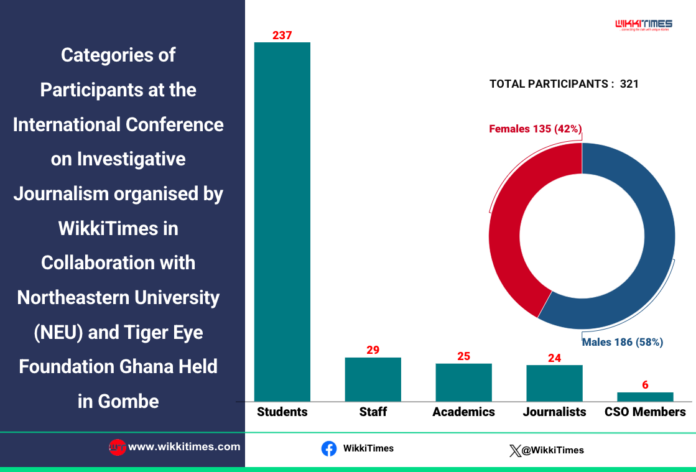
Students covered the highest percentage of the participants at the recently concluded international conference on investigative journalism, organised by WikkiTimes in collaboration with Northeast University (NEU) and Ghana’s Tiger Eye Foundation.
The conference held on March 4 in Gombe, brought together a diverse range of 321 participants, with journalism students from the North-Eastern University and the Federal University Kashere – making up the highest number of the participants.
The event featured renowned Ghana-based investigative journalist Anas Aremeyaw Anas and other media experts who provided insights into the evolving landscape of investigative reporting.
Data from the conference indicate a large student presence demonstrating a keen interest in investigative journalism among aspiring reporters.

Of the 321 participants, 58% were males (186 participants) and 42% females (135 participants).
Students made up 237, representing 74% of the total attendees, University staff made up 9% (29 participants), Journalists accounted for 7% (24 participants), while academics represented 8% (25 participants), and Civil Society Organization (CSO) members comprised 2% (6 participants).
WikkiTimes had earlier reported that in his determination to expand the frontiers of investigative journalism, Anas instituted a ten-year annual prize for the best-graduating students in investigative journalism at North-Eastern University (NEU), Gombe, and Federal University, Kashere (FUK).
He announced that each year, the top graduates will receive a $300 award, funded by his foundation, Tiger Eye Foundation Ghana.
WikkiTimes, as a lead partner is expected to provide mentorship and practical support to the students of the benefitting institutions.
“Investigative journalism requires resources. This initiative is my way of encouraging young journalists to pursue this path with excellence, integrity, and resilience, he said.
Anas stated in his keynote address that there must be collaboration to strengthen the profession across borders.
“Investigative journalists are the last line of defense for democracy, and we must keep pushing the frontiers to ensure accountability. Our work should uplift communities and foster development. If we fail to do this, then we have failed as journalists.”
Also, Professor Umaru Pate, the Vice Chancellor of Federal University, Kashere, said that investigative journalism is necessary in society as he is committed to training students who can be globally competitive journalists.
“I am not training locally minded journalists. I train individuals who can operate on the global stage, adapt to contemporary challenges, and make a meaningful impact worldwide.”